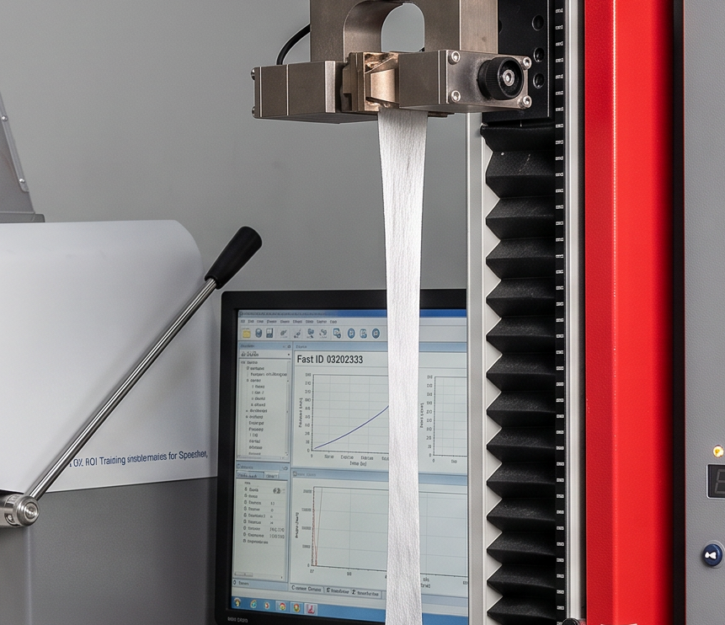
Magnera Introduces Universa™
Universa™ is a new, consolidated range of industrial wipers that brings together the trusted performance of the legacy Chicopee® and Sontara® brands. Developed by combining the manufacturing expertise,…


Technology Zone
Nonwoven fabrics bond fibres together mechanically, thermally or chemically instead of weaving or knitting them. This zone covers spunbond, meltblown, needlepunch and spunlace, and the filtration, hygiene, medical and geotextile products they end up in.
Latest in this zone
Universa™ is a new, consolidated range of industrial wipers that brings together the trusted performance of the legacy Chicopee® and Sontara® brands. Developed by combining the manufacturing expertise,…
What this zone covers
A nonwoven is a fabric made straight from fibre, and the first decision is how the web is laid. Drylaid webs are carded or airlaid from staple fibre and give bulk and loft. Wetlaid webs are formed from a fibre slurry on a paper machine and give a fine, even sheet. Spunlaid webs, spunbond and meltblown, extrude polymer straight onto the belt, which is the cheapest route per square metre and the reason it dominates hygiene and medical.
The web has no strength until it is bonded. Needlepunching drives barbed needles through and entangles the fibres mechanically; hydroentanglement, or spunlace, does the same with fine water jets and gives a softer fabric. Thermal calendering melts a bonding fibre or the polymer itself at points. Chemical bonding sprays or saturates a binder. Each route sets strength, drape, porosity and cost, and they are routinely combined.
Spunbond filaments are drawn and laid continuously, giving strength and dimensional stability at low weight. Meltblown fibres are blown by hot air into micro diameters, giving almost no strength but an enormous surface area and a very fine pore structure. The SMS laminate puts a meltblown barrier between two spunbond layers, which is why one construction covers surgical gowns, hygiene backsheets and filter media.
Basis weight, thickness, fibre diameter and pore size are the four numbers that decide what a nonwoven does. Filtration wants a controlled pore distribution and a fine fibre; wipes want absorbency and wet strength; geotextiles want puncture resistance and permeability at the same time. The same polymer serves all of them, and the structure, not the chemistry, is what makes them different products.
Finishing decides more than it is credited for: hydrophilic or hydrophobic treatment, antistatic, flame retardant, calendering for smoothness, or electret charging that gives a filter media its efficiency without any extra pressure drop. Recycling is where the pressure now sits, since most nonwovens are single use and multi-polymer, and single-polymer constructions are the direction the market is moving in.
| Parameter | Typical range | Rule of thumb |
|---|---|---|
| Basis weight | 10 to 30 g/m2 hygiene, 100 to 800 g/m2 geotextile | Everything is priced and specified per square metre; convert before comparing |
| Fibre diameter | Spunbond 15 to 25 micron, meltblown 1 to 5 micron | Filtration efficiency follows fibre diameter far more than it follows weight |
| Needlepunch density | 50 to 500 punches per cm2 | More punches give strength and lose thickness and permeability |
| Hydroentanglement pressure | 50 to 400 bar across several manifolds | Build up gradually; the first manifold pre-wets, the last consolidates |
| Thermal bond area | 12 to 25 % of the surface | More bonding area gives strength and a stiffer, papery handle |
| Air permeability | 100 to 5000 l/m2/s depending on construction | Quote at the standard pressure difference or the number means nothing |
| Tensile, machine and cross direction | MD to CD ratio 1.5:1 to 4:1 | Anisotropy is set at web forming; bonding cannot undo it |
| Electret charge retention | Efficiency falls with humidity, oil and time | Test loaded, not clean, or the filter performs on paper only |
| Symptom | Likely causes | What to do |
|---|---|---|
| Weight varies across the width | Uneven web forming, worn card clothing, or airflow imbalance on a spunlaid line | Profile the weight across the width with a scanner, balance the airflow, and service the forming section before adjusting downstream |
| Fabric delaminates in use | Bond area too low, calender temperature below the polymer window, or an incompatible bonding fibre | Check the calender temperature and nip pressure against the polymer, and confirm the bonding fibre melts below the carrier fibre |
| Needles break frequently | Wrong needle for the fibre, penetration depth too great, or a hard particle in the web | Match the needle gauge and barb to the fibre, reduce penetration, and check the opening line for contamination |
| Filter efficiency falls after storage | Electret charge decaying, humidity, or oil mist in the environment | Test with a loading agent as the standard requires, protect the media in storage, and consider a mechanical rather than a charged construction |
| Spunlace fabric is soft but weak | Insufficient jet energy, too high a line speed, or a fibre too coarse to entangle well | Raise the pressure in the later manifolds, slow the line, and consider a finer fibre or a blend |
| Pinholes in a lightweight spunbond | Spinneret partly blocked, polymer contamination, or moisture in the resin | Clean the spinneret pack, dry the resin to specification, and check the filtration in the melt line |
| Roll telescopes or blocks in storage | Winding tension profile wrong, or residual binder tacking under warm conditions | Set a taper tension profile, cure the binder fully, and control the storage temperature |
Go deeper: news and case studies · frequently asked questions
Equipment Guide

 Sandler AG
One of the world's leading manufacturers of nonwovens, with more than 140 years of history in Schwarzenbach an der Saale. Develops and produces nonwoven solutions for cleaning and wiping, filtration, protection, acoustic and thermal insulation and upholstery. Materials serve construction, household, hygiene, industrial and mobility sectors; also operates Sandler Nonwoven Corporation in Perry, Georgia.
Sandler AG
One of the world's leading manufacturers of nonwovens, with more than 140 years of history in Schwarzenbach an der Saale. Develops and produces nonwoven solutions for cleaning and wiping, filtration, protection, acoustic and thermal insulation and upholstery. Materials serve construction, household, hygiene, industrial and mobility sectors; also operates Sandler Nonwoven Corporation in Perry, Georgia.
 Fibertex Nonwovens A/S
At Fibertex Nonwovens, we pioneer and innovate the way industries work with nonwovens and performance materials. We manufacture a wide range of high-performance nonwovens, using advanced technologies, the best practices and quality materials, to enable our customers to create high-performance solutions that improve the quality of life for people.
Fibertex Nonwovens A/S
At Fibertex Nonwovens, we pioneer and innovate the way industries work with nonwovens and performance materials. We manufacture a wide range of high-performance nonwovens, using advanced technologies, the best practices and quality materials, to enable our customers to create high-performance solutions that improve the quality of life for people.
 PrimaLoft, Inc.
Since 1984, PrimaLoft has made high performance, sustainable insulation. At PrimaLoft, our insulation is made for real use: in the cold, in the wet, through active movement and in extreme conditions. PrimaLoft insulation starts with synthetic microfibers. From there, different constructions and technologies are engineered to deliver lightweight warmth, breathable comfort, durable protection or temperature regulation.
PrimaLoft, Inc.
Since 1984, PrimaLoft has made high performance, sustainable insulation. At PrimaLoft, our insulation is made for real use: in the cold, in the wet, through active movement and in extreme conditions. PrimaLoft insulation starts with synthetic microfibers. From there, different constructions and technologies are engineered to deliver lightweight warmth, breathable comfort, durable protection or temperature regulation.
 Magnera Corporation
US-based producer of nonwovens and specialty materials, formed from the combination of Glatfelter and Berry Global's Health, Hygiene & Specialties business. Makes engineered fabrics and films used in healthcare, hygiene, wipes, construction, filtration, food and beverage, beauty care, electrical and technical nonwoven applications, from 46 manufacturing facilities globally.
Magnera Corporation
US-based producer of nonwovens and specialty materials, formed from the combination of Glatfelter and Berry Global's Health, Hygiene & Specialties business. Makes engineered fabrics and films used in healthcare, hygiene, wipes, construction, filtration, food and beverage, beauty care, electrical and technical nonwoven applications, from 46 manufacturing facilities globally.
Ask the Expert
Engineers and product specialists who answer technical questions from readers. The answer comes back to you by e-mail; when we publish it, other readers benefit too.
No field expert for this zone yet — your question still reaches our editors.
"*" indicates required fields
Questions and answers
When the job is a barrier, a filter, an absorbent layer or a single use product, and when cost per square metre matters more than tear strength or drape. Nonwovens are made in one continuous step from fibre to fabric, so they are far cheaper; they give up tensile strength, abrasion resistance and repairability. Anything that has to survive many wash cycles usually goes back to woven or knitted.
Spunbond for strength and dimensional stability, meltblown for barrier and filtration. Meltblown fibres are one to five microns across, which gives enormous surface area and a fine pore structure but almost no strength, so it is nearly always used between spunbond layers. The SMS laminate exists precisely because neither one does the whole job.
Needlepunching is cheaper, handles heavy weights and gives a strong, bulky fabric, which is why geotextiles and automotive felts use it. Hydroentanglement uses fine water jets, works at lower weights, damages the fibre less and gives a much softer fabric, which is why wipes and medical fabrics use it. The water treatment plant is the hidden cost of the second.
By fibre diameter and pore structure first, then by weight. Efficiency comes from how fine the fibres are and how the pores are distributed, and pressure drop comes from the same structure, so the two always trade against each other. Ask for efficiency at a stated particle size and face velocity, tested loaded rather than clean, and check whether the efficiency depends on an electret charge.
Because the fibres are laid preferentially along the machine as the web forms, and no amount of bonding changes their orientation. A ratio of two or three to one is normal. Where the application needs balance, cross-lapping the web or using a randomised card is the answer, and both cost speed.
Single-polymer constructions can, and that is the direction the industry is moving. The problem has always been the laminates and the binders: an SMS structure with a polypropylene layer, a polyester scrim and an acrylic binder is three materials in one sheet. Designing the product so every layer is the same polymer costs a little in performance and makes the end of life possible at all.
It captures fine particles by electrostatic attraction rather than by blocking them, which gives high efficiency at low pressure drop. It is also the part that fades: humidity, oil aerosols and time all discharge the media, and a filter that tested well when new can drop a class in service. This is why the standards now require testing with a loading agent, and why some critical applications specify a purely mechanical media.
The zone is the editorial side: news, case studies, videos, newsletter editions and field experts. The Equipment Guide is the directory side: equipment types and the manufacturers that build them. This page links to its Equipment Guide category and back.
Open the Equipment Guide category for this zone, pick an equipment type and open a manufacturer profile. Partner profiles carry direct contact details; other listings link to the company website.
Yes. Ask the Expert puts your question to a field expert in this zone. The answer comes back to you by e-mail; when we publish it, other readers benefit too.