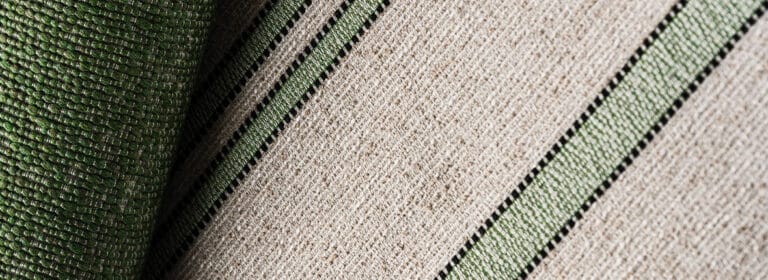
Sunbrella Completes Its Transition To PFAS-Free Fabrics
All Sunbrella fabrics are now manufactured without PFAS, ahead of the European PFHxA restriction that takes effect in October 2027.


Technology Zone
Coated textiles carry a polymer or resin layer that adds water resistance, flame retardancy and abrasion resistance. This zone covers coating and laminating processes, the polymers used, and the fabrics they become for outdoor, industrial and architectural use.
Latest in this zone
All Sunbrella fabrics are now manufactured without PFAS, ahead of the European PFHxA restriction that takes effect in October 2027.
What this zone covers
A coated textile is a composite of a substrate that carries the load and a polymer layer that provides the function: watertightness, chemical resistance, grip, flame retardance, gas barrier or simply a printable surface. The substrate decides strength, dimensional stability and tear behaviour; the coating decides everything the product is bought for. Most failures in service are adhesion failures between the two, not failures of either one alone.
Direct coating spreads the compound straight onto the fabric with a knife over roller, over air or over blanket, and it is the cheapest route for heavier layers. Transfer coating builds the film on release paper and marries it to the fabric afterwards, which gives a smoother surface and lets a delicate substrate carry a thick layer. Lamination bonds a ready-made film or membrane with adhesive, heat or flame, and is what breathable outerwear uses.
PVC plastisol is cheap, weldable and easy to formulate, and it carries truck tarpaulins and banners. Polyurethane gives elasticity, low temperature flexibility and a softer handle, in solvent, water-based and thermoplastic forms. Silicone survives heat, cold and weathering and is chemically inert, which is why it goes on airbags and industrial belting. Acrylics and rubbers fill the space in between, chosen on cost and on the exposure the product will see.
A coating sticks because the surface was prepared. Corona or plasma treatment raises the surface energy of a polyolefin, a primer or adhesion promoter bridges two incompatible chemistries, and the substrate has to be clean and dry, with spin finish and sizing removed. Peel strength is a specification, tested and recorded, and a batch that peels below it is a batch that will delaminate on the customer's roof.
A plastisol gels and fuses, a solvent system flashes off and cures, a two-component polyurethane crosslinks over hours or days. Under-curing leaves a coating that feels finished and fails early; over-curing embrittles it and can damage the substrate. After that come welding and seaming, which only work if the polymer is thermoplastic, and the end of life, where a PVC-coated polyester is two materials that are hard to separate.
| Parameter | Typical range | Rule of thumb |
|---|---|---|
| Coating weight | 20 to 100 g/m2 for apparel, 200 to 900 g/m2 for tarpaulin | Specify per square metre per side; total weight hides an uneven split |
| Peel adhesion | 20 to 100 N/50 mm depending on the construction | Test wet and after heat ageing, not only dry and fresh |
| Surface energy after treatment | Above 38 dyne/cm for good wetting | Corona treatment decays; coat within hours, not days |
| Curing temperature | PVC fusion 160 to 190 degrees, PU cure 120 to 160 | Measure the web temperature, not the oven set point |
| Line speed | 5 to 60 m/min depending on coat weight and cure | Cure time, not the coating head, usually sets the speed |
| Hydrostatic head | 1,300 mm rainwear, 10,000 mm and up technical | Test after abrasion and flexing; a new sample flatters the product |
| Breathability | MVTR 3,000 to 20,000 g/m2/24h | Compare on one test method; the numbers between methods are not interchangeable |
| Cold crack temperature | PVC minus 20, PU minus 40, silicone minus 60 | Choose on the coldest handling temperature, not the coldest service temperature |
| Symptom | Likely causes | What to do |
|---|---|---|
| Coating delaminates in service | Insufficient surface treatment, spin finish left on the substrate, or the wrong primer for the polymer pair | Verify the surface energy before coating, scour the substrate, and re-qualify the primer with a heat-aged peel test |
| Pinholes in the film | Air entrapped in the compound, moisture in the substrate, or too thin a first pass | Degas the compound, dry the fabric, and split the coat weight over two passes |
| Coating weight varies across the width | Knife not parallel, roller worn, or the fabric tension profile uneven | Set the knife gap across the width against a gauge, check roller runout, and even out the tension with spreader rollers |
| Product stiffens and cracks after a season outdoors | Plasticiser migration in PVC, UV degradation, or a coating cured too hard | Move to a polymeric plasticiser or another polymer, add UV stabiliser, and check the cure profile |
| Welds fail on the seam | Surface contamination, wrong weld temperature or speed, or a coating that is not thermoplastic | Clean the weld area, run a weld window trial and peel test, and confirm the polymer can be welded at all |
| Fabric curls or bows after coating | One-sided shrinkage, tension out of balance, or uneven drying | Balance the coat between the sides where the construction allows, and reset the tension and the drying profile |
| Colour drifts between batches | Pigment dispersion, cure temperature variation, or substrate colour showing through a thin coat | Control the cure temperature, check dispersion, and raise the opacity of the base coat |
Go deeper: news and case studies · frequently asked questions
Equipment Guide
 Dickson Constant SAS
French manufacturer of technical textiles, known for solution-dyed acrylic and coated technical fabrics under the Dickson and Sunbrella brands. Ranges cover solar protection (awnings, blinds, screen fabrics), marine fabrics, indoor and outdoor upholstery and woven vinyl flooring. European arm of US-based Glen Raven; completed a full transition to PFAS-free fabrics in 2026.
Dickson Constant SAS
French manufacturer of technical textiles, known for solution-dyed acrylic and coated technical fabrics under the Dickson and Sunbrella brands. Ranges cover solar protection (awnings, blinds, screen fabrics), marine fabrics, indoor and outdoor upholstery and woven vinyl flooring. European arm of US-based Glen Raven; completed a full transition to PFAS-free fabrics in 2026.
 Sympatex GmbH
Makes high-tech functional membranes and laminates that are waterproof, windproof and breathable, based on a polyester membrane that is PTFE- and PFAS-free. Materials are used in outdoor and workwear apparel, footwear, uniforms and accessories, positioned around recyclability and closed-loop Fiber2Fiber production. Now a brand of PIDIGI S.p.A.
Sympatex GmbH
Makes high-tech functional membranes and laminates that are waterproof, windproof and breathable, based on a polyester membrane that is PTFE- and PFAS-free. Materials are used in outdoor and workwear apparel, footwear, uniforms and accessories, positioned around recyclability and closed-loop Fiber2Fiber production. Now a brand of PIDIGI S.p.A.
 Sioen Industries NV
Belgian vertically integrated manufacturer of coated technical textiles, with three divisions: Technical Textiles (woven and nonwoven fabrics, coated textiles, films, laminates and composites), Colouring Solutions and Protective Clothing. Its coated fabrics serve transport and automotive, construction, energy, maritime, agriculture and events.
Sioen Industries NV
Belgian vertically integrated manufacturer of coated technical textiles, with three divisions: Technical Textiles (woven and nonwoven fabrics, coated textiles, films, laminates and composites), Colouring Solutions and Protective Clothing. Its coated fabrics serve transport and automotive, construction, energy, maritime, agriculture and events.
 Arville Textiles Limited
At Arville Textiles, we stand at the forefront of technical textile innovation, bringing cutting-edge solutions to industries worldwide. With over 65 years of experience, we have established ourselves as a trusted provider of high-performance textiles, driven by a relentless pursuit of excellence.
Our core values revolve around quality, reliability, and customer-centricity. We believe in forging strong partnerships with our clients, understanding their unique challenges, and delivering tailored textile solutions that exceed expectations. From aerospace and defense to automotive, filtration, industrial, and personal protection, we provide a diverse range of technical fabrics that meet the most demanding requirements.
Arville Textiles Limited
At Arville Textiles, we stand at the forefront of technical textile innovation, bringing cutting-edge solutions to industries worldwide. With over 65 years of experience, we have established ourselves as a trusted provider of high-performance textiles, driven by a relentless pursuit of excellence.
Our core values revolve around quality, reliability, and customer-centricity. We believe in forging strong partnerships with our clients, understanding their unique challenges, and delivering tailored textile solutions that exceed expectations. From aerospace and defense to automotive, filtration, industrial, and personal protection, we provide a diverse range of technical fabrics that meet the most demanding requirements.
 Mehler Texnologies GmbH (MehlerHeytex)
Manufactures coated technical textiles — PVC-coated polyester fabrics, hi-tech meshes and composite membranes under the VALMEX and POLYMAR brands. Since the merger of Mehler Texnologies and Heytex within Freudenberg Performance Materials it trades as MehlerHeytex, supplying truck tarpaulins, textile architecture, solar protection, marine and containment, print media and agricultural fabrics.
Mehler Texnologies GmbH (MehlerHeytex)
Manufactures coated technical textiles — PVC-coated polyester fabrics, hi-tech meshes and composite membranes under the VALMEX and POLYMAR brands. Since the merger of Mehler Texnologies and Heytex within Freudenberg Performance Materials it trades as MehlerHeytex, supplying truck tarpaulins, textile architecture, solar protection, marine and containment, print media and agricultural fabrics.
 ContiTech AG
Textile Conveyor Belts with Fabric Reinforcement for the Most Varied of Conveying Applications. For over 150 years, our breakthrough fabric designs have been tested in some of the toughest conveyor belt applications worldwide. These high-quality belt constructions give you the confidence you need for operating performance.
ContiTech AG
Textile Conveyor Belts with Fabric Reinforcement for the Most Varied of Conveying Applications. For over 150 years, our breakthrough fabric designs have been tested in some of the toughest conveyor belt applications worldwide. These high-quality belt constructions give you the confidence you need for operating performance.
Ask the Expert
Engineers and product specialists who answer technical questions from readers. The answer comes back to you by e-mail; when we publish it, other readers benefit too.
No field expert for this zone yet — your question still reaches our editors.
"*" indicates required fields
Questions and answers
Direct coating is the cheapest and suits heavier layers on a stable substrate. Transfer coating builds the film on release paper first, so the surface is smoother and a light or open fabric can carry a thick layer without the compound striking through. Lamination bonds a ready-made film or membrane and is what you use when the functional layer is made by someone else, as with breathable membranes.
PVC for cost, weldability and heavy outdoor duty such as tarpaulins and banners. Polyurethane for softness, elasticity and low temperature flexibility, which is why it dominates apparel and technical fabrics. Silicone where heat, cold and chemical exposure rule everything else out, at a price several times higher. The end of life also differs: PVC on polyester is genuinely hard to recycle.
Almost always because the surface was not ready. Polyolefin substrates have low surface energy and need corona or plasma treatment, and that treatment decays within hours. Spin finishes, sizes and softeners left on the fabric act as release agents. Test the surface energy before the coating head, and qualify peel strength after heat ageing, not just on fresh samples.
Only within one test method. MVTR by the upright cup, the inverted cup and the sweating hotplate give numbers that differ by a factor of several, and suppliers quote whichever flatters. Ask which method and which conditions, and if the product is worn, ask for RET as well, because that is the figure that correlates with what a wearer feels.
How much water pressure a new, flat sample resists. It says nothing about what happens after the fabric has been abraded at the shoulders, flexed at the elbows or seam-sealed badly. Ask for the value after a flex and abrasion cycle, and remember that in a finished garment the seams, not the fabric, usually fail first.
With difficulty, because they are two materials bonded together on purpose. The routes that work are single-polymer constructions, a polyester substrate with a polyester-based coating for example, or mechanical separation where the coating can be stripped. It is an active area, and specifying a mono-material construction at design time is far cheaper than solving it at the end.
Less than most specifications ask for, if the substrate is right. Coat weight is the most expensive variable in the product, and doubling it rarely doubles the performance: pinholes, adhesion and the evenness of the first pass matter more. Two thinner passes usually outperform one thick one, and cost less in compound than the failures they prevent.
The zone is the editorial side: news, case studies, videos, newsletter editions and field experts. The Equipment Guide is the directory side: equipment types and the manufacturers that build them. This page links to its Equipment Guide category and back.
Open the Equipment Guide category for this zone, pick an equipment type and open a manufacturer profile. Partner profiles carry direct contact details; other listings link to the company website.
Yes. Ask the Expert puts your question to a field expert in this zone. The answer comes back to you by e-mail; when we publish it, other readers benefit too.