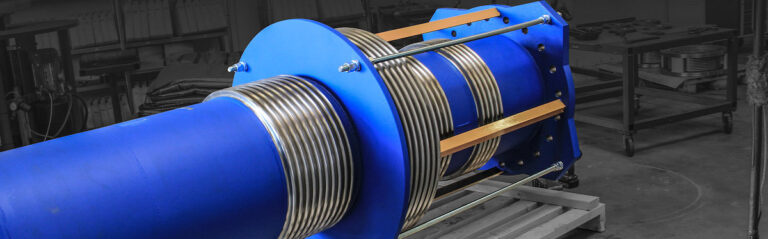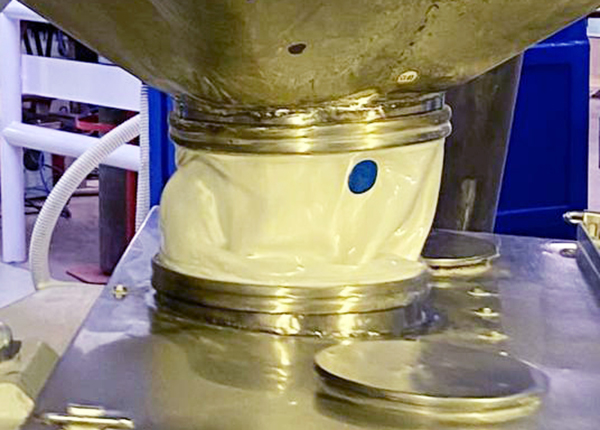
Large Oscillating Sifters Create Flexible Connection Challenge
A global leader in the manufacture of home and personal care products was experiencing problems with heavy leakage on a particularly aggressive sifter.

Technology Zone
Flexible connections join piping and machines and absorb movement, vibration and misalignment. This zone covers expansion joints, compensators, flexible sleeves and hoses for product and air transfer, plus shaft protection.
Latest in this zone
A global leader in the manufacture of home and personal care products was experiencing problems with heavy leakage on a particularly aggressive sifter.

Promoted videos
What this zone covers
Rigid pipe and rigid machines do not coexist. A flexible connection absorbs the movement between them: thermal growth, vibration from a fan or a screw, settlement of a foundation, and the misalignment that every installation has whether or not the drawing shows it. Without one, that movement lands on flanges, bearings and welds, and it is the reason a perfectly specified machine develops cracks in its first year.
A fabric compensator is a multi-layer belt: an outer weather layer, insulation, a gas-tight membrane, and a structural fabric that carries the pressure. They handle large movements in every direction at low cost and low reaction force, which is why ducting, flue gas and dust extraction use them everywhere. They are temperature limited, they age, and they are inspection items with a defined service life rather than fit and forget parts.
A rubber bellows takes vibration and moderate movement in liquid lines and damps noise, with a limited temperature and chemical range. A metal bellows handles high temperature, pressure and vacuum and lasts far longer, at a much higher reaction force and a much lower tolerance for lateral movement. Which one is right follows from the movement, the medium and the temperature, in that order.
Every joint absorbs axial, lateral and angular movement, and each type has its own limits for each. Combining movements eats the allowance far faster than any single one. Just as important, a bellows under pressure generates a thrust that has to be carried by anchors and guides, and a compensator installed without them will simply push the pipework apart. The anchor design is part of the joint specification, not an afterthought.
Flexible sleeves and hoses connect chutes, silos, filling heads and machines that move. In product transfer the wear point is the inside surface, so a liner is chosen for abrasion; in dust extraction the concern is static, so a conductive layer and correct earthing matter more than the wall thickness. Both are consumables with a predictable life, and both are usually replaced too late.
| Parameter | Typical range | Rule of thumb |
|---|---|---|
| Axial movement | Fabric joints 50 to 300 mm, rubber 10 to 40, metal 10 to 50 | Combined movements reduce each allowance; never add them independently |
| Operating temperature | Rubber to 100, PTFE to 250, fabric with insulation to 600, metal to 900 degrees | Specify the peak, including upset and start-up, not the average |
| Pressure rating | Fabric joints near atmospheric, rubber to 16 bar, metal much higher | Fabric compensators are for ducting, not for pressure lines |
| Bellows thrust | Effective area times pressure, often several tonnes | Design the anchors for the thrust before selecting the bellows |
| Guide spacing | First guide within 4 pipe diameters, second within 14 | Missing guides turn an axial bellows into a buckled one |
| Hose bend radius | 6 to 10 times the inside diameter, more when pressurised | A kinked hose has lost its rating permanently |
| Conductivity for dust duty | Surface resistance under 1e9 ohm | Bond and earth both ends; a conductive layer that is not earthed does nothing |
| Service life | Fabric joints 3 to 8 years, rubber 5 to 10 | Put them on a replacement schedule, not on a failure schedule |
| Symptom | Likely causes | What to do |
|---|---|---|
| Fabric compensator fails within a year | Temperature above the belt rating, condensate attacking the membrane, or movement beyond the design | Measure the real duct temperature and dew point, and re-specify the belt build for the actual conditions |
| Pipework moves and pulls at the machine | Missing anchors or guides, so the bellows thrust goes into the pipe run | Add main anchors either side of the bellows and guides at the correct spacing; the joint is not the problem |
| Rubber bellows swells and softens | Chemical incompatibility with the medium, or temperature above the elastomer rating | Match the elastomer to the medium, and consider a PTFE lined joint where the chemistry is aggressive |
| Metal bellows cracks at the convolutions | Lateral movement it was not designed for, fatigue from vibration, or chloride stress corrosion | Re-check the movement analysis, isolate the vibration source, and select a material suited to the chloride level |
| Sleeve wears through on one side | Product stream hitting one point, misalignment, or a liner too thin for the abrasive | Realign, fit a wear liner or a rotating deflector, and set a replacement interval based on measured wear |
| Static shocks at a filling point | Non-conductive sleeve, or a conductive layer that is not bonded to earth at both ends | Fit a conductive sleeve and verify the earth continuity with a meter, not by inspection |
| Joint leaks at the flange | Bolt torque uneven, gasket wrong for the temperature, or the flange face damaged | Re-torque in sequence to the specified figure, and check the flange faces for flatness and damage |
Go deeper: flexible connections news and case studies · frequently asked questions
Material Guide
 Flexible Connections Ltd
 are a family run business with over 30 years experience in the design and manufacture of flexible connectors. Complimenting our in house design team we have sewing, plastic welding and rubber bonding production capabilities for manufacturing bespoke flexibles with short lead times.
Flexible Connections Ltd
Flexible Connections Ltd are a family run business with over 30 years experience in the design and manufacture of flexible connectors. Complimenting our in house design team we have sewing, plastic welding and rubber bonding production capabilities for manufacturing bespoke flexibles with short lead times.
 Arville Textiles Limited
At Arville Textiles, we stand at the forefront of technical textile innovation, bringing cutting-edge solutions to industries worldwide. With over 65 years of experience, we have established ourselves as a trusted provider of high-performance textiles, driven by a relentless pursuit of excellence.
Our core values revolve around quality, reliability, and customer-centricity. We believe in forging strong partnerships with our clients, understanding their unique challenges, and delivering tailored textile solutions that exceed expectations. From aerospace and defense to automotive, filtration, industrial, and personal protection, we provide a diverse range of technical fabrics that meet the most demanding requirements.
Arville Textiles Limited
At Arville Textiles, we stand at the forefront of technical textile innovation, bringing cutting-edge solutions to industries worldwide. With over 65 years of experience, we have established ourselves as a trusted provider of high-performance textiles, driven by a relentless pursuit of excellence.
Our core values revolve around quality, reliability, and customer-centricity. We believe in forging strong partnerships with our clients, understanding their unique challenges, and delivering tailored textile solutions that exceed expectations. From aerospace and defense to automotive, filtration, industrial, and personal protection, we provide a diverse range of technical fabrics that meet the most demanding requirements.
 Ductmate Industires Inc.
At Ductmate Industries, we are proud to be a leading manufacturer and supplier of HVAC products and solutions. With a wealth of experience in the industry, we have built a strong reputation for delivering high-quality, innovative, and reliable duct system components.
Ductmate Industires Inc.
At Ductmate Industries, we are proud to be a leading manufacturer and supplier of HVAC products and solutions. With a wealth of experience in the industry, we have built a strong reputation for delivering high-quality, innovative, and reliable duct system components.
Ask the Expert
Engineers and product specialists who answer technical questions from readers. The answer comes back to you by e-mail; when we publish it, other readers benefit too.
No field expert for this zone yet — your question still reaches our editors.
E-Product & Market Insights
Every E-Product and Market Insight edition takes one technology or one market in depth. These are the editions on this zone, so read them online or get the next one by e-mail.
Join 7,000+ product developers, technologists and technical buyers. Free, and you pick the editions.
"*" indicates required fields
What this zone covers
Fabric for ducting at low pressure with large movements and high temperature, which covers flue gas, dust extraction and hot air. Rubber for liquid lines where vibration and noise are the problem and temperature is moderate. Metal where temperature or pressure rules the other two out. Movement, medium and temperature answer this in that order, and price only afterwards.
In most cases because it was installed without anchors and guides. A bellows under pressure generates a thrust equal to the effective area times the pressure, often several tonnes, and if the pipework is not anchored that force simply extends or buckles the joint. The second most common cause is a temperature or a dew point above what the belt build was specified for.
Give axial, lateral and angular movement separately, with the direction and the number of cycles, and state whether they occur together. Combined movements consume the allowance far faster than any single one, and a joint sized on axial movement alone will fail early if the line also moves sideways. Include start-up and upset conditions, not just steady state.
Yes, and treating them as permanent is the usual mistake. Fabric compensators typically last three to eight years, rubber joints five to ten, depending on temperature, chemistry and movement. They belong on a replacement schedule with an inspection round in between, because the failure mode is usually a leak into a hot or dusty area rather than a clean break.
A conductive sleeve is only conductive if it is bonded at both ends and the continuity is measured. A sleeve interrupts the metal path between two pieces of equipment, so without a bonding strap or a conductive layer that is actually earthed, charge accumulates exactly where product is moving and dust is present. Measure with a meter as part of commissioning and again on a routine.
For a small tear in the outer layer, temporarily yes, and there are wrap systems designed for it. But the layer that matters is the gas-tight membrane inside, and once that has gone the repair is cosmetic. Since these are consumable items with a known service life, a planned replacement during a shutdown is nearly always cheaper than a repair that has to be redone.
Close to the source of the movement, with anchors on both sides and guides at the correct spacing, and never where it will also have to carry the weight of the pipework. Installing it at the machine flange to absorb misalignment that should have been fixed by alignment is a common and expensive shortcut, because the joint then works at its limit from day one.
The zone is the editorial side: news, case studies, videos, newsletter editions and field experts. The Equipment Guide is the directory side: equipment types and the manufacturers that build them. This page links to its Equipment Guide category and back.
Open the Equipment Guide category for this zone, pick an equipment type and open a manufacturer profile. Partner profiles carry direct contact details; other listings link to the company website.
Yes. Ask the Expert puts your question to a field expert in this zone. The answer comes back to you by e-mail; when we publish it, other readers benefit too.