
Technology Zone
Woven Fabrics, Laid Webs, Braidings, Knitted Fabrics
Woven fabrics, laid webs, braidings and knitted fabrics each build structure in a different way. This zone covers interlaced wovens, unidirectional laid webs, braided sleeves and ropes, and warp and weft knits for clothing and industrial use.
All articles in this zone
Woven Fabrics, Laid Webs, Braidings, Knitted Fabrics — page 1 of 1
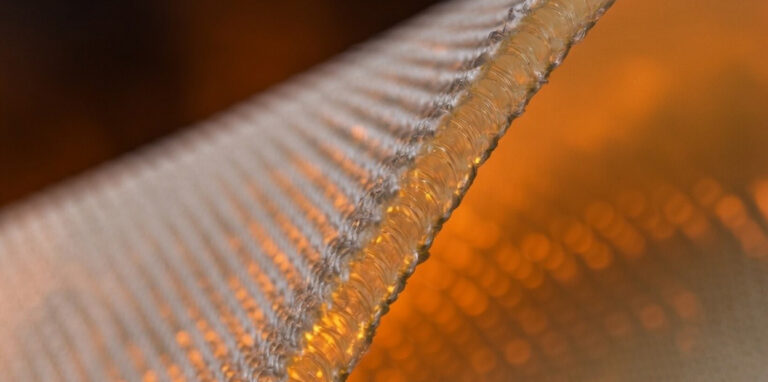

What this zone covers
Woven Fabrics, Laid Webs, Braidings, Knitted Fabrics: how it works, key numbers and troubleshooting
Fundamentals
Weaving: two yarn systems at right angles
A woven fabric interlaces warp, which runs along the length and is under tension on the loom, with weft, which is inserted across. The pattern of that interlacing is the weave: plain gives the most interlacings and the firmest, most stable cloth; twill gives fewer, so it drapes better and shows a diagonal; satin gives the fewest and produces a smooth, lustrous face at the cost of snagging. Almost every technical woven is a variation on those three.
Insertion: rapier, air-jet, projectile
How the weft crosses the loom decides speed, yarn range and cost. Rapier looms handle almost any yarn including coarse and delicate technical ones, at moderate speed. Air-jet looms are the fastest for fine, regular yarns and dominate high volume. Projectile looms cover wide, heavy fabrics such as geotextiles and tarpaulin base cloth. Water-jet suits hydrophobic filament. The choice is usually made by the yarn, not by the fabric.
Knitting: one yarn, loops
Knitted fabric is loops pulled through loops, which is why it stretches in every direction and recovers. Weft knitting builds loops across the fabric from one yarn and covers jersey, rib and interlock as well as whole-garment and flat-bed technical shapes. Warp knitting builds loops down the fabric from many yarns and gives dimensionally stable, run-resistant fabrics: tricot, raschel, spacer fabrics and net.
Braiding and laid webs
Braiding interlaces three or more yarns diagonally around an axis, which gives ropes, sleeves, hoses and reinforcement that follows a shape without darts. Laid webs place straight yarn layers at chosen angles and stitch or bond them, which keeps the full yarn strength because there is no crimp. Both matter in composites and in reinforcement, where crimp is a loss you cannot afford.
Preparation and finishing decide the sale
The greige fabric off the loom is not the product. Singeing, desizing, scouring, bleaching, mercerising, heat setting, dyeing, printing and mechanical or chemical finishing all follow, and each one changes width, weight, strength and handle. Fabric specifications should be quoted finished, and a fabric that meets its weight in greige will not meet it after finishing.
Key parameters
| Parameter | Typical range | Rule of thumb |
|---|---|---|
| Fabric weight | Shirting 100 to 150, denim 300 to 450, geotextile 200 to 800 g/m2 | Always quote finished weight at standard conditioning |
| Thread count | Ends and picks per cm, both directions | Cover factor, not thread count alone, decides opacity and air permeability |
| Crimp | Warp 5 to 12 %, weft 3 to 8 % | Crimp costs strength; laid or non-crimp constructions exist for that reason |
| Loom speed | Air-jet 800 to 1500 picks/min, rapier 400 to 700, projectile 300 to 500 | Wider fabric costs speed; compare in metres of weft per minute |
| Warp tension | Steady within a few percent across the width | Uneven tension is the root of most weaving faults and of bow and skew |
| Knitting stitch length | Set per course; controls weight, width and handle | Stitch length, not machine speed, is the quality-setting parameter |
| Gauge | Fine gauge E28 to E40 for apparel, E5 to E14 for technical | Gauge and yarn count must match; the wrong pair breaks needles |
| Shrinkage after finishing | Under 3 % after five washes for stable apparel | Heat set and pre-shrink before cutting, not after complaints |
Troubleshooting
| Symptom | Likely causes | What to do |
|---|---|---|
| Streaks along the warp direction | Tension variation between beam sections, mixed yarn lots, or a damaged reed | Check tension across the width, inspect the reed dents, and keep lots separated through warping |
| Weft bars across the fabric | Count or twist variation between weft packages, or a stop mark after a loom stop | Mix packages, check the count on arrival, and set the pick-finding so restarts do not leave a mark |
| Bow and skew in the finished cloth | Uneven tension in finishing, a stenter out of alignment, or an asymmetric weave pulling | Align the stenter chains, correct the overfeed, and check bow with a template before the fabric is rolled |
| Holes and dropped stitches in knitting | Damaged needles, yarn tension too high, or a knot passing through | Change the damaged needles, lower and even the yarn tension, and use splicing rather than knots |
| Knitted fabric spirals after washing | Torque in a single jersey knitted from a highly twisted yarn | Use a balanced or plied yarn, or a rib or interlock structure, and set the fabric properly |
| Warp breaks rise suddenly | Size removed or applied unevenly, dry atmosphere, or a rough element in the yarn path | Check the size pick-up and the humidity, and run a hand along the yarn path for wear |
| Fabric width off specification after finishing | Overfeed and stenter width set for a different quality, or shrinkage not stabilised | Re-establish the finishing recipe for that construction and confirm with a washed sample, not a dry one |
Go deeper: news and case studies · frequently asked questions
Equipment Guide
Woven Fabrics, Laid Webs, Braidings, Knitted Fabrics in the Equipment Guide
4 equipment types
Recommended manufacturers
 Dickson Constant SAS
French manufacturer of technical textiles, known for solution-dyed acrylic and coated technical fabrics under the Dickson and Sunbrella brands. Ranges cover solar protection (awnings, blinds, screen fabrics), marine fabrics, indoor and outdoor upholstery and woven vinyl flooring. European arm of US-based Glen Raven; completed a full transition to PFAS-free fabrics in 2026.
Dickson Constant SAS
French manufacturer of technical textiles, known for solution-dyed acrylic and coated technical fabrics under the Dickson and Sunbrella brands. Ranges cover solar protection (awnings, blinds, screen fabrics), marine fabrics, indoor and outdoor upholstery and woven vinyl flooring. European arm of US-based Glen Raven; completed a full transition to PFAS-free fabrics in 2026.
 Sioen Industries NV
Belgian vertically integrated manufacturer of coated technical textiles, with three divisions: Technical Textiles (woven and nonwoven fabrics, coated textiles, films, laminates and composites), Colouring Solutions and Protective Clothing. Its coated fabrics serve transport and automotive, construction, energy, maritime, agriculture and events.
Sioen Industries NV
Belgian vertically integrated manufacturer of coated technical textiles, with three divisions: Technical Textiles (woven and nonwoven fabrics, coated textiles, films, laminates and composites), Colouring Solutions and Protective Clothing. Its coated fabrics serve transport and automotive, construction, energy, maritime, agriculture and events.
 Schoeller Textil AG
Swiss weaving and textile-finishing company producing functional woven fabrics and finishing technologies for performance apparel and workwear. Note: the company website could not be reached during research, so the profile still needs verification.
Schoeller Textil AG
Swiss weaving and textile-finishing company producing functional woven fabrics and finishing technologies for performance apparel and workwear. Note: the company website could not be reached during research, so the profile still needs verification.
 Kvadrat A/S
Kvadrat was established in Denmark in 1968 and has deep roots in Scandinavia's world-famous design tradition. A leader in design innovation, Kvadrat produces high-performance, design textiles, rugs, window covering and acoustic solutions for both commercial and residential interiors. Our products reflect our commitment to colour, quality, simplicity and innovation.
Kvadrat A/S
Kvadrat was established in Denmark in 1968 and has deep roots in Scandinavia's world-famous design tradition. A leader in design innovation, Kvadrat produces high-performance, design textiles, rugs, window covering and acoustic solutions for both commercial and residential interiors. Our products reflect our commitment to colour, quality, simplicity and innovation.
 Porcher Industries SA
Designs and manufactures technical textiles and composite materials, including glass and carbon yarns, woven and coated fabrics, scrims, thermoplastic prepregs and laminates. Materials serve aerospace and defence, automotive, building, industry, sports and leisure and interior design. Vertically integrated from fibre and yarn through weaving, coating and composite part materials.
Porcher Industries SA
Designs and manufactures technical textiles and composite materials, including glass and carbon yarns, woven and coated fabrics, scrims, thermoplastic prepregs and laminates. Materials serve aerospace and defence, automotive, building, industry, sports and leisure and interior design. Vertically integrated from fibre and yarn through weaving, coating and composite part materials.
 ISKO (Sanko Tekstil)
ISKO is a global denim company with more than 100 years of experience innovating within the textile domain. Known for our dedication to fashion, craftsmanship, and sustainability, our patented technologies enhance comfort, performance, and durability. Our range includes casual wear, workwear, and of course denim. We work every day to uphold denim and textile culture while leading the change toward a sustainable and circular textile industry.
ISKO (Sanko Tekstil)
ISKO is a global denim company with more than 100 years of experience innovating within the textile domain. Known for our dedication to fashion, craftsmanship, and sustainability, our patented technologies enhance comfort, performance, and durability. Our range includes casual wear, workwear, and of course denim. We work every day to uphold denim and textile culture while leading the change toward a sustainable and circular textile industry.
 Arville Textiles Limited
At Arville Textiles, we stand at the forefront of technical textile innovation, bringing cutting-edge solutions to industries worldwide. With over 65 years of experience, we have established ourselves as a trusted provider of high-performance textiles, driven by a relentless pursuit of excellence.
Our core values revolve around quality, reliability, and customer-centricity. We believe in forging strong partnerships with our clients, understanding their unique challenges, and delivering tailored textile solutions that exceed expectations. From aerospace and defense to automotive, filtration, industrial, and personal protection, we provide a diverse range of technical fabrics that meet the most demanding requirements.
Arville Textiles Limited
At Arville Textiles, we stand at the forefront of technical textile innovation, bringing cutting-edge solutions to industries worldwide. With over 65 years of experience, we have established ourselves as a trusted provider of high-performance textiles, driven by a relentless pursuit of excellence.
Our core values revolve around quality, reliability, and customer-centricity. We believe in forging strong partnerships with our clients, understanding their unique challenges, and delivering tailored textile solutions that exceed expectations. From aerospace and defense to automotive, filtration, industrial, and personal protection, we provide a diverse range of technical fabrics that meet the most demanding requirements.
 SAERTEX GmbH & Co. KG
Develops and produces textile reinforcement materials for fibre composites, mainly multiaxial and unidirectional non-crimp fabrics from glass, carbon, aramid and natural fibres, plus core materials and cut kits. Materials are used for lightweight components in wind energy, aerospace, automotive, boatbuilding and industry, with production and kit-cutting sites worldwide.
SAERTEX GmbH & Co. KG
Develops and produces textile reinforcement materials for fibre composites, mainly multiaxial and unidirectional non-crimp fabrics from glass, carbon, aramid and natural fibres, plus core materials and cut kits. Materials are used for lightweight components in wind energy, aerospace, automotive, boatbuilding and industry, with production and kit-cutting sites worldwide.
Ask the Expert
Ask a woven fabrics, laid webs, braidings, knitted fabrics expert — free
Engineers and product specialists who answer technical questions from readers. The answer comes back to you by e-mail; when we publish it, other readers benefit too.
No field expert for this zone yet — your question still reaches our editors.
Subscribe to our E-newsletters
"*" indicates required fields
Questions and answers
Frequently asked about woven fabrics, laid webs, braidings, knitted fabrics
Woven or knitted for this application?
Woven where dimensional stability, strength in defined directions and low elongation matter: technical reinforcement, filtration, tarpaulins, workwear. Knitted where stretch, recovery and conformity to a shape matter, and increasingly where a three-dimensional shape can be knitted directly instead of cut and sewn. Warp knits sit in between: dimensionally stable, run-resistant, and still a knit.
Plain, twill or satin?
Plain weave has the most interlacings, so it is the firmest, most stable and most abrasion resistant, and the least drapey. Twill has fewer, which gives better drape, a higher achievable thread count and the familiar diagonal. Satin has the fewest, giving a smooth lustrous face that snags easily. For technical fabrics the choice is usually plain for stability or twill for drape and cover.
What does crimp cost me?
Strength and stiffness, because a crimped yarn straightens before it loads. In apparel that is fine and even useful, since it gives stretch and recovery. In composite reinforcement it is a direct loss, which is exactly why non-crimp fabrics and laid webs exist: the yarns stay straight and are held by stitching instead of by interlacing.
Which loom type suits a technical yarn?
Rapier, in most cases. It handles coarse, delicate, slippery and irregular yarns that an air-jet cannot carry, and it manages colour and multiple weft types. Air-jet wins on speed with fine regular yarns, and projectile wins on wide heavy fabrics such as geotextiles. Ask what the yarn is before asking what the loom costs.
Why does my knitted fabric twist?
Torque in the yarn. A single jersey knitted from a highly twisted single yarn stores that twist and releases it in the first wash, so the fabric spirals. The fixes are a plied or balanced yarn, a structure that opposes itself such as rib or interlock, or proper setting. It cannot be finished out afterwards in any lasting way.
Should I specify greige or finished fabric?
Finished, always, at standard conditioning. Preparation and finishing change width, weight, strength, shrinkage and handle, sometimes by a lot, so a greige specification tells you almost nothing about what arrives. Specify finished weight, finished width and the shrinkage after a stated number of washes, and ask for the test method with the number.
What is a spacer fabric for?
It is a warp-knitted three-dimensional structure with two faces held apart by monofilament pile, giving thickness, compression recovery and airflow in one textile. That combination replaces foam in seating, mattresses, orthopaedic supports and shoe uppers, with the advantages that it breathes, it recovers after long compression and it is a single material, which makes recycling far simpler than a laminate.
What is the difference between this Technology Zone and the Equipment Guide?
The zone is the editorial side: news, case studies, videos, newsletter editions and field experts. The Equipment Guide is the directory side: equipment types and the manufacturers that build them. This page links to its Equipment Guide category and back.
How do I find a manufacturer of woven fabrics, laid webs, braidings, knitted fabrics equipment?
Open the Equipment Guide category for this zone, pick an equipment type and open a manufacturer profile. Partner profiles carry direct contact details; other listings link to the company website.
Can I ask a technical question before I buy?
Yes. Ask the Expert puts your question to a field expert in this zone. The answer comes back to you by e-mail; when we publish it, other readers benefit too.