
From Bespoke Satellites to Industrialized Platforms
With the rapid rise of “New Space” applications, ranging from communication constellations to Earth observation systems, the industry is moving away from bespoke, one-off satellites toward repeatable, industrialized platforms. This transition is not only changing how satellites are built, but also how they are conceived from the very beginning. This is particularly visible in the rapid expansion of LEO constellations, where production cycles and cost structures have become as critical as performance itself.
How can engineers reconcile the traditionally uncompromising performance demands of space systems with the need for cost-efficient, high-volume production?
From Performance to Production-Ready Design
Historically, satellite structures were optimized for maximum performance: ultra-lightweight, highly engineered, and often produced in very limited numbers. Today, however, timelines are shrinking, constellations are growing, and cost pressures are increasing.
This has led to a more holistic engineering approach, one that integrates materials, design, and manufacturing processes from the outset. Structural concepts must now meet not only mechanical and thermal requirements, but also criteria such as repeatability, manufacturability, and scalability.
Materials in particular are playing a pivotal role in enabling this transition. Increasingly, materials that qualify for space do not just enable missions, they set the benchmark for performance, reliability, and scalability across industries on Earth.
Why Carbon Fiber Composites Matter More Than Ever
Carbon fiber reinforced composites have long been valued in aerospace applications for their exceptional strength-to-weight ratio. In the context of next-generation satellites, their importance is growing even further.
Their unique combination of properties makes them particularly suitable for space environments:
- Low MassLow mass, supporting launch cost reduction
- High StiffnessHigh stiffness, ensuring structural integrity
- Minimal Thermal ExpansionMinimal thermal expansion, maintaining dimensional stability under extreme temperature cycles
These characteristics are essential not only for primary load-bearing structures, but also for components requiring extreme precision. This applies, for example, to structural elements such as satellite panels, antenna reflectors or support structures, where dimensional stability directly impacts system performance.
Beyond performance, carbon fiber composites also offer something increasingly valuable: design flexibility. Engineers can tailor structures more precisely to functional requirements, while simultaneously considering manufacturability.
The Role of Advanced Material Systems
The future of satellite development will not be defined by performance alone, but by the ability to translate material innovation into scalable, production-ready solutions.
Jana Kubitz Head of Sales & Marketing Aerospace, EMEA at Teijin Carbon
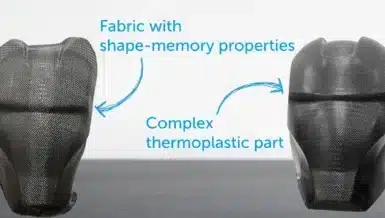
This shift is redefining how materials, design, and manufacturing must interact in modern satellite architectures. Material innovation is evolving alongside changing industry requirements. Today’s composite solutions go beyond traditional thermoset systems and increasingly incorporate thermoplastic technologies.
For example, carbon fiber-based thermoset prepregs continue to play a key role in applications requiring high dimensional accuracy and thermal stability. At the same time, thermoplastic composites are gaining traction due to their compatibility with faster and more automated production processes.
These materials offer advantages such as:
- High-Rate Manufacturingpotential for high-rate manufacturing
- Processing Efficiencyimproved processing efficiency
- Impact Resistance and Durabilityenhanced impact resistance and durability
In combination, these material systems enable engineers to balance performance with production requirements, a critical factor in the context of large satellite constellations.
Manufacturing as a Design Driver
One of the most significant and often underestimated shifts is the growing influence of manufacturing on design decisions.
Technologies such as automated fiber placement (AFP) and advanced forming processes are no longer just production tools. They are becoming key enablers of architectural concepts. The feasibility of a satellite structure is increasingly defined by how efficiently it can be produced at scale.
This evolution marks a departure from the traditional linear development model. Instead, manufacturing considerations are now embedded early in the design phase, influencing everything from geometry to material layups.
The result is a new type of satellite architecture – one that is not only optimized for performance, but also for industrialization.
Towards Scalable Space Systems
As the space industry continues to expand, the ability to translate advanced material technologies into scalable solutions will become a defining competitive factor.
Carbon fiber composites and the architectures built around them are central to this development. By enabling lightweight, stable, and production-ready structures, they help bridge the gap between high-performance engineering and industrial efficiency.
This is where material development moves beyond theoretical performance and becomes engineering reality. For companies like Teijin Carbon, this translates into a clear engineering focus: not only meeting extreme performance requirements, but enabling repeatable, certifiable, and increasingly scalable solutions for aerospace applications.
This includes ongoing work in advanced thermoset and thermoplastic systems, as well as rapid-cure technologies that enable higher production rates without compromising structural performance or qualification standards.
In this sense, the future of satellite design will not be determined by performance alone. It will depend on how effectively materials, processes, and system requirements are combined into cohesive, scalable solutions.