
Market
Agriculture
Agrotech covers shade and crop protection nets, ground cover, silage film, greenhouse screens, fleece and root control fabrics. UV stability across the growing season, and increasingly whether the fabric can be collected and recycled or safely degrades in the field, decide what growers are willing to buy.
All articles in this market
Agriculture — page 1 of 1

Ask the Expert
Ask a agriculture expert — free
Engineers and product specialists who answer technical questions from readers. The answer comes back to you by e-mail; when we publish it, other readers benefit too.
No field expert for this market yet — your question still reaches our editors.
Subscribe to our E-newsletters
"*" indicates required fields
Questions and answers
Frequently asked about agriculture
Agricultural fabrics & textiles
For ages, textiles have been used in the field of agriculture for processes in food production and extensively in the fishing industry in the form of products like nets, ropes, and lines. In addition, textiles are also used to protect crops and fertilization. As the world's population continually grows, stress on agricultural crops has increased. It is, therefore, necessary to increase the yield and quality of agro-products.
What does agro textiles mean?
Textile fabrics have a long history of use in agriculture. The term “agro textiles” now is used to categorize the woven, nonwoven and knitted fabrics used for agricultural and horticultural applications including livestock protection, shading, weed and insect control, and extension of the growing season.
Agro textiles are used in farming, animal husbandry, and horticulture to control the hazardous influences of environmental and climatic factors on crop production and cattle breeding, regulate the nutrient level intake of plants, and assist in the process and postharvest operations.

What are the functions of agro textiles?
Agro textiles are an emerging sector among the twelve sectors of technical textiles. Agro textiles products can be woven, non-woven, or knitted (mostly Agro textile products are knitted) and are used for various purposes
-
- Used to prevent soil erosion and to build roads for afforestation
- Used as a cover for the greenhouse
- To make rows of crops on the land
- The land is used to clear unwanted grassy areas
- Used as resistant to sunlight
- Used to prevent excess air
- Used in agricultural equipment packaging
- Used for fishing
- Protects crops from bird attack
- Increases the water-holding capacity of the land
- Agro textiles can be used in several applications and fields
- Fishing nets: Fishing nets are knitted fabrics
- Windshield: The windshield protects crops, small trees, and plants from strong winds. Healthy trees can be seen if they are protected from strong winds
- Harvesting nets: Fruits, which are susceptible to mold infections, darkened kernels, and insect and bug invasion due to laying on the ground, can be protected by this net
- Packing Material: These nets are used for packing various farm products
- Bird protection net: It protects seeds, crops, and fruit from damage, caused by birds and other pests. But the mesh size is big enough to allow the movement of bees
- And many more

Important properties of agro textiles
The key functional properties of agro-textile products are as follows:
-
- Light Weight
- Weather resistance
- Resistance to micro-organisms
- Resistant to solar radiation
- Resistant to ultraviolet radiation
- Abrasion resistance
- Water conservation
- Stable construction
- Tensile strength
- Protection properties
Innovations in agro textiles
The global rise in population and growing demand for better and high-quality vegetables and fruits are the primary growth driver for agro textiles. According to the United Nations, Food and Agricultural Organization (FAO) the global food production capacity will have to increase by 70% from the present level by 2050 to suffice the population.
Currently, the agro-textile market is dominated by polyolefins or petrochemical-based agro-textiles. However, climate change and an increase in greenhouse gas emissions have raised concern about the future oil-based economy, and petroleum-based agro-textiles have become expensive and less desirable in the modern world.
Other products include agro-textiles based on natural fibers, which degrade so fast in the environment that their recovery from the field becomes difficult to even by efficient recycling or combustion. Hence, the development of bio-based agro-textiles is foreseen to initiate economic growth.
Which fabrics are used for crop protection?
Leno and raschel knitted nets carry shade, hail and insect protection because they hold their mesh opening under load. Woven ground cover keeps weeds down while letting water through, and the mesh geometry is what sets the light transmission a grower is paying for. More in Woven Fabrics and Knitted Fabrics.
Where are nonwovens used in agriculture?
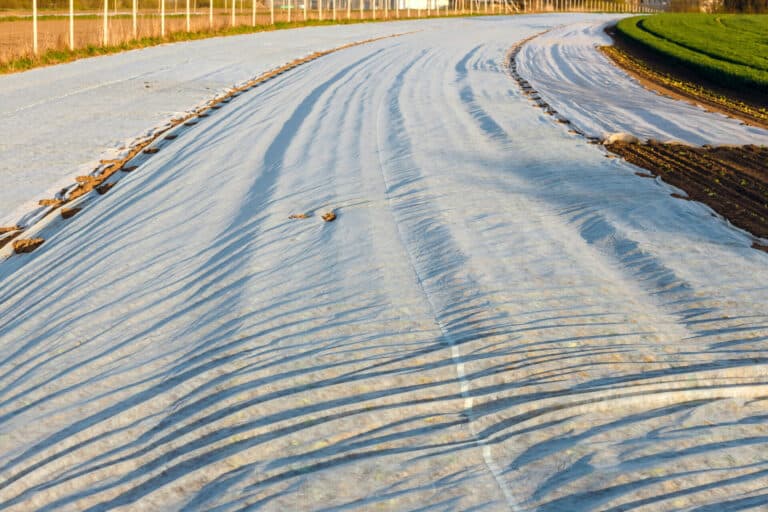
Spunbond fleece protects early crops against frost and insects while letting light and water through, and heavier nonwovens are used for root control, capillary matting and silage covers. Weight per square metre is the number growers buy on. More in Nonwoven Fabrics.
Which polymers survive a season in the field?
Polyethylene and polypropylene with UV stabiliser packages carry almost everything outdoors, and the stabiliser dosage rather than the polymer decides how many seasons the fabric lasts. Bio-based and degradable variants are available where collection is impractical. More in Fibers and Yarns.
What is changing in agricultural textiles?
Recycling schemes for used film and net, degradable mulch that can be ploughed in, and photoselective fabrics that steer the light spectrum toward a specific crop are the areas with real movement. Most of it is being proven in field trials right now. More in Research and Development.
How do I find an equipment manufacturer for agriculture?
Use the Manufacturers Directory A–Z or the Equipment Guide. Partner profiles carry direct contact details; other listings link to the company website.
Can I ask a technical question before I buy?
Yes. Ask the Expert puts your question to a field expert active in Agriculture. The answer comes back to you by e-mail; when we publish it, other readers benefit too.